


MINT SQUARE ARTICLE
Inside Retail Media DOOH: An Interview with INOVISCO
How Europe's largest independent in-store screen network gets read, remembered, and proven to sell.
Ever wondered what actually happens, media-wise, on the walk from the parking lot to the checkout? We put the question to INOVISCO Mobile Media, the team behind one of the largest in-store screen networks in the DACH region and the marketer of the screen network with the widest reach across EDEKA stores. In this interview, they share how digital city light posters, in-store DOOH and roadside screens come together into one seamless programmatic DOOH product, plus a genuinely surprising result: a measured sales lift for Danone Volvic, demonstrating just how much impact DOOH can have right at the point of purchase.
Q: Could you briefly introduce INOVISCO and describe the role you play in the DOOH ecosystem?
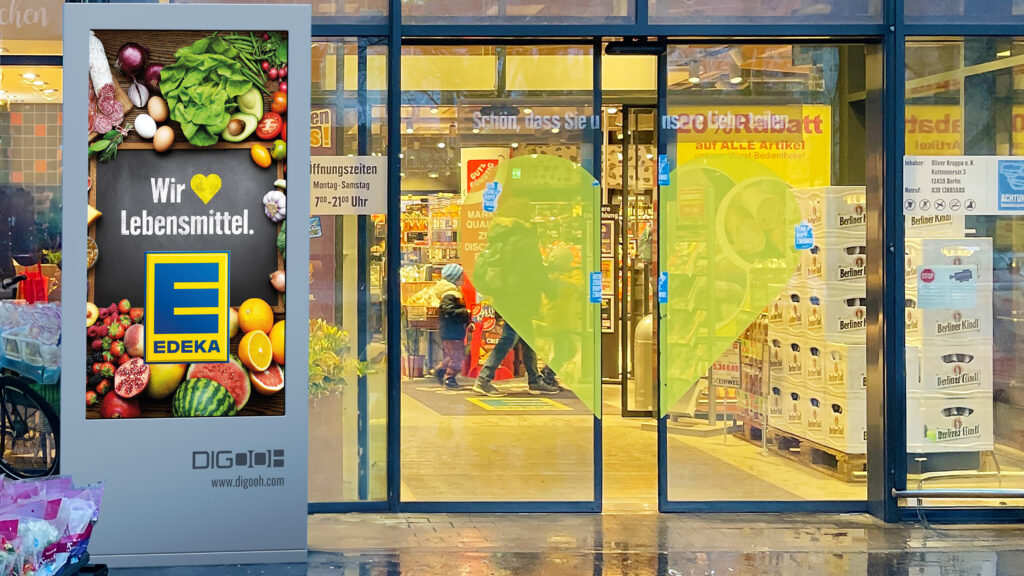
A: INOVISCO has been a full-service provider for Ambient Media and Digital Out-of-Home in the DACH region since 2004. Our focus is where media and purchase decisions physically converge: in retail. In the EDEKA environment, we market one of the highest-reach networks of digital advertising screens in the entrance areas of grocery retail stores.
Since 2026, we have significantly expanded this role. Firstly, the HIT hypermarkets of the Dohle Group have been added. In addition, we are the central Booking Hub of the Retail Media Alliance – a cooperation between DIGOOH Media, INOVISCO Mobile Media, EMSU and Verve Retail Media, which includes VIEWENTO and acardo. Through us as the central sales partner, media agencies in particular, as well as advertisers, can book more than 3,300 locations and over 5,000 screens, almost 4,000 of them within the EDEKA network, with a weekly reach of more than 46 million gross contacts. The chain extends from the entrance display through the sales floor and checkout to the coupon on the receipt, supplemented within one booking by Roadside DOOH for the journey to the store – all through a single point of contact.
Our function in the ecosystem is therefore that of an aggregator: we translate fragmented retail infrastructure into a media product that can be planned, booked and billed uniformly – traditionally via IO or programmatically, through a single point of contact. And we do so independently of retailers. INOVISCO is Germany’s largest independent marketer in brick-and-mortar retail, belonging neither to a retail group nor to an Out-of-Home corporation.
Q: From your perspective, what can DOOH contribute to the media mix that other channels cannot provide in the same way?
A: Three things that no other channel delivers in this combination.
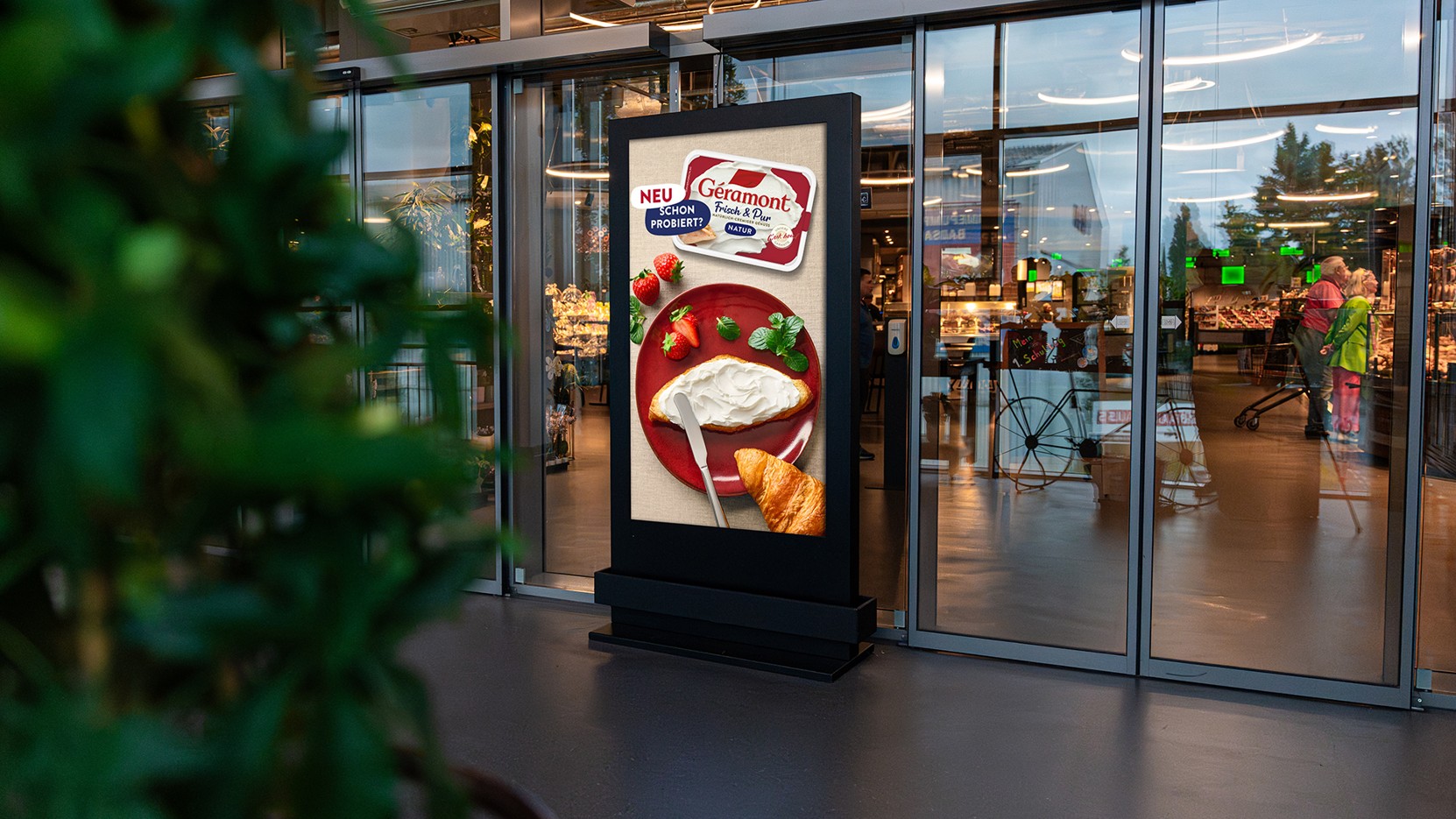
First: contextual proximity to the decision. A screen at the store entrance reaches people immediately before they shop, while the shopping list in their head is still open. This combination of physical location, timing and shopping role cannot be replicated in the digital space.
Second: unavoidable attention. No ad blocker, no skip, no scroll. The advertising is part of the physical space. Our DCLP formats reach 88 percent of people entering the store, with an average viewing time of more than five seconds. And the touchpoint has an impact. In a series of studies, we were able to achieve unaided brand recall values up to six times higher than with traditional posters.
Third – and this is new: proof of sales impact. For Danone Volvic, we measured a campaign in the EDEKA network alongside its execution. The result: a 16 percent increase in sales during a period in which the category as a whole was declining. At the same time, unaided brand recall developed more than twice as strongly as for the competition. DOOH therefore moves beyond a pure awareness role and demonstrably contributes to revenue on the retail floor.
Q: From your perspective, what has changed most significantly in DOOH over the past 2–3 years?
A: In-Store DOOH has reversed the burden of proof. Three years ago, we still had to explain why the channel belonged in the plan at all. Today, the question is how large its share should be.
Several developments have been decisive. Programmatic has transformed DOOH from a booking channel into an activation channel: flexible campaign periods, short-notice booking and data-driven selection. And Retail Media has brought In-Store out of the trade-marketing corner. Screens in stores are now regarded as a media channel with their own currency.
Infrastructure expansion has created screen inventories nationwide in recent years that did not previously exist – including in medium-sized towns and rural areas, where traditional Out-of-Home networks become sparse but a significant share of purchasing power is located. National campaigns can therefore, for the first time, truly be national within people’s real-life environments.
We ourselves are driving the fourth change: consolidation. In-Store was long a patchwork of providers and systems without end-to-end planning. This is exactly what we are resolving with the Retail Media Alliance. For agencies, that is the real leap forward, because the channel can now be planned like any other media category.
Q: What typical mistakes or misconceptions do you still observe among advertisers or agencies when dealing with DOOH?
A: The most common mistake is evaluation based purely on reach logic. DOOH is compared with online display on the basis of CPM – a comparison that ignores the quality of the contact. A contact shortly before the purchase decision in brick-and-mortar grocery retail carries a different weight from an ad impression in a feed. More than 90 percent of grocery retail sales continue to be generated in physical stores.
Second: separating Retail Media and DOOH into separate budget pots. In-Store screens are both. When these budgets sit in different areas, the channel falls between the cracks, even though it provides exactly the bridge both sides are looking for.
Third: equating environment with product category, especially among Non-Endemics. Many advertisers read “supermarket” and think “FMCG”. In doing so, they exclude themselves from an environment in which their target group is operating in exactly the right role: as household decision-makers, weekly, with high frequency and strong purchasing power.
Fourth: creative development that only begins after media planning. A 10-second contact at the store entrance is not a miniature TV spot. Every touchpoint has its own rules: at the entrance, content is perceived while passing by; at the checkout, people are standing still for more than 40 seconds. The same creative can work in one place and fizzle out in another. Anyone who does not tailor the advertising asset to the contact situation gives away its strength.
Q: Beyond pure reach, what makes a DOOH environment or placement particularly valuable for advertisers?
A: The answer is always: proximity to the action you want to trigger.
In grocery retail, there are four qualities. We reach household decision-makers in their shopping role. There are only minutes between contact and purchase. The screen does not compete with fifteen other advertising spaces. And the contact takes place in the real world, without ad fraud, without bot impressions, without contextual risk. Brand Safety is a physical characteristic here.
The decisive point, however, is the combination. Entrance, sales floor, checkout and couponing together form a system: Awareness at the entrance, Consideration at the shelf, Conversion at the checkout, and proof of impact through coupon redemption. This combination is precisely the reason for the Retail Media Alliance.
And this environment is not only relevant for endemic brands. Someone standing in a supermarket is not deciding exclusively about yoghurt and detergent. They are in the role of household decision-maker, and in that role holidays, insurance, kitchens, cars or garden furniture are also discussed. The EDEKA shopper has above-average purchasing power and broader interests than the shopping cart might suggest.
For Non-Endemics, understanding the context is therefore crucial: What is happening in the target group’s mind at the moment they see the screen? Anyone who can answer that uses In-Store for durable goods, consumer activation or travel offers, in an environment with high attention and hardly any competition from the advertiser’s own industry.
This effect is particularly strong outside metropolitan areas. There, traditional Out-of-Home networks simply lack advertising inventory; in practice, they end at the edge of the city. Until now, Non-Endemics have been able to reach this target group almost exclusively digitally. Screens in supermarkets, full-range retailers, petrol stations, DIY stores and drugstores close precisely this gap with physical, high-frequency reach in an environment with clear target-group quality.
Q: How has Programmatic Buying changed the way advertisers use your inventory, and what options are available to them today?
A: Programmatic has lowered the barrier to entry and increased precision. Campaigns no longer run in rigid weekly blocks, but according to location, time of day, day of the week or external triggers such as weather, promotional periods and seasonality. Brands can test on a small scale and scale quickly when something works.
For our inventory, this means specifically: In-Store formats in the EDEKA environment are accessible through the common DSPs, individually or in combination, billed using standardised contact metrics.
Programmatic is an access route, not a discount model. The most valuable In-Store inventory is curated inventory. We therefore rely on clearly defined deals rather than open auction logic at any price.
Q: Which creative approaches work particularly well in your environments – and which mistakes do you see repeatedly?
A: Radical reduction works. One message, one product, one call to action. Brand early and large, product clearly recognisable, movement used selectively as an attention-grabber. Contextual relevance beats generic creative – recipe idea, weather relevance, promotional period, availability in the store. And what works particularly well is the integration with the coupon. When the screen announces the promotion and the receipt redeems it, coupon redemption rates and sales increase measurably.
The most common mistakes: the 1:1 repurposed social spot, text set at body-copy size, and the late logo reveal after eight seconds.
Q: If you could give a brand planning its first DOOH campaign just one piece of advice – what would it be?
A: Don’t think too small – and plan measurement from the outset.
The most common reason why a first DOOH campaign is not extended is the lack of proof. And that proof is rarely missing because the channel does not work, but because the test was designed on too small a scale. If you start with only a handful of stores and a short campaign period, you risk generating effects that simply get lost in the noise. Even a test needs a meaningful number of stores and sufficient reach for the impact to be distinguishable from chance.
That is why the measurement design should be defined in advance: which stores form the test group, which form the control group, which period is being compared, and which metric determines success. Then, after the campaign, you have a result that can be used to make an internal case. Anyone who runs a campaign without a measurement plan ends up with an invoice and a gut feeling. Anyone who tests on too small a scale does not even have that.
In the In-Store environment, this is particularly feasible because sales data and coupon redemptions are available as hard reference points. This is exactly how the Volvic case came about.
Q: Where do you see DOOH in the coming years, and which developments should advertisers and the industry keep a particularly close eye on?
A: Four developments.
DOOH and Retail Media are converging. The question “Is this Out-of-Home advertising or Retail Media?” becomes irrelevant. It is a channel with two parent disciplines, and the most interesting budgets emerge at this interface.
Competition is shifting from reach to demonstrable impact. Networks that can prove impact will distinguish themselves from those that only deliver contacts. Standardised measurement – also driven by industry associations – is a prerequisite for this.
Infrastructure independence is becoming a selection criterion. If the marketer and the largest buyer sit within the same corporate group, neutral activation is structurally difficult. In future, advertisers should ask more closely who owns the stack through which their budget runs. We have deliberately positioned ourselves as an independent partner and thereby open up locations that cannot be reached through closed systems.
Demand is broadening. In-Store Retail Media is currently driven predominantly by endemic budgets. The growth reserve lies in Automotive, financial services, tourism, Entertainment and Telco. Anyone who wants to unlock these budgets must talk about target-group context rather than screens.
For us, the conclusion is: In-Store is moving from an add-on to a standard line item in the media plan – for networks that deliver reach, consistency and proof of impact at the same time.