MINT SQUARE ARTICLE
Is DOOH Right for Your Client?
Not every objective needs a screen. Here's how to tell.
Is DOOH Right for Your Client?
Not every objective needs a screen. Here’s how to tell.
Programmatic DOOH is a genuinely flexible channel, but that doesn’t mean it’s the answer to every brief. Here’s when it earns its place in the plan, and when it doesn’t.
When it’s a strong fit
When you want to reach a broad, geographically concentrated audience quickly around a brand or product moment, DOOH is usually a strong choice. It delivers reach and frequency fast, in an environment people trust, without needing individual-level personal data to work.
It’s a weaker fit when a campaign needs to reach a narrow, hard-to-define niche with no reliable geographic concentration, or when the message genuinely requires one-to-one personalisation that only a channel like email or CRM-based retargeting can deliver.
One nuance worth knowing: audience-first planning has raised the ceiling on what counts as “reachable.” A few years ago, “our audience is too specific for outdoor” was often true. Today, with tools like The Trade Desk’s ARP scoring screens by how strongly a defined audience indexes nearby, and location-intelligence partners like Adsquare showing who’s likely to pass a given site, audiences that once looked too niche for DOOH can frequently be reached efficiently. The right question isn’t “is my audience big enough for billboards?” anymore. It’s “can my audience be described behaviourally or geographically well enough for the plan to find where it concentrates?”
Objectives that play to DOOH’s strengths
Some objectives suit DOOH directly: broad reach, high trust, strong visual impact. Here’s how each typically looks in practice:
- Brand awareness: a new wellness brand launches in major cities with gym, station and mall placements, building broad reach fast ahead of a wider media push.
- Product launches: an automotive brand unveiling a new model runs a dominant, high-impact takeover near dealerships and around a motor show, timed to the announcement. Keep the message simple: product, benefit, brand.
- Retail promotions: a supermarket promotes a weekend offer near selected branches, geotargeted around store catchments and scheduled to align exactly with the promotion window.
- Store visits: a QSR chain opening a new location drives footfall using screens within a defined drive-time radius, then measures the uplift with a footfall partner. This needs suitable scale and pre-launch setup.
- Event promotion: a festival or B2B conference is promoted along transit routes and near the venue in the weeks before, building momentum as the date approaches.
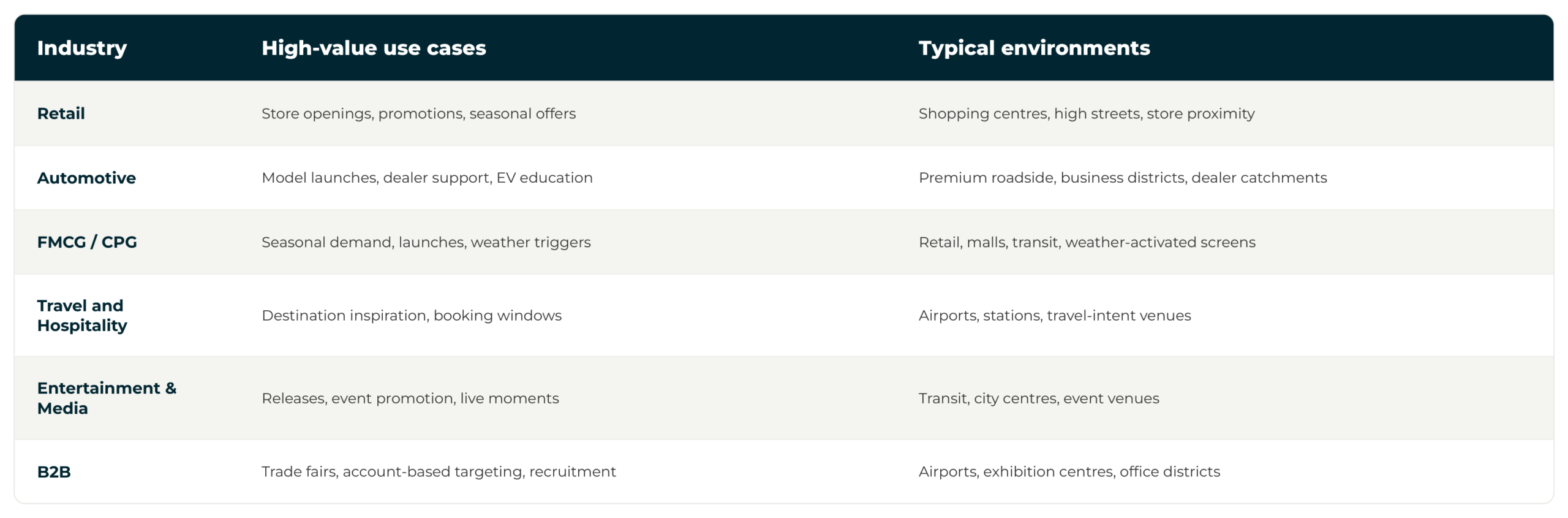
Which industries tend to see the fastest wins
This isn’t an exclusion list; it’s a starting point for where the fastest wins usually are. Scale matters too: local campaigns (a single city or store list) are the tightest fit for a first attempt, while regional and national campaigns follow the same logic, just planned alongside a wider footprint.
Budgeting for reach, not screen count
Clients often ask how many screens they can get for their budget. The more useful question is whether the plan creates enough reach and frequency in the right environments to support the objective. A campaign spread across too many cities may look impressive on a media plan but feel invisible in the market. A focused campaign in fewer places usually creates stronger impact.
The five-factor decision framework
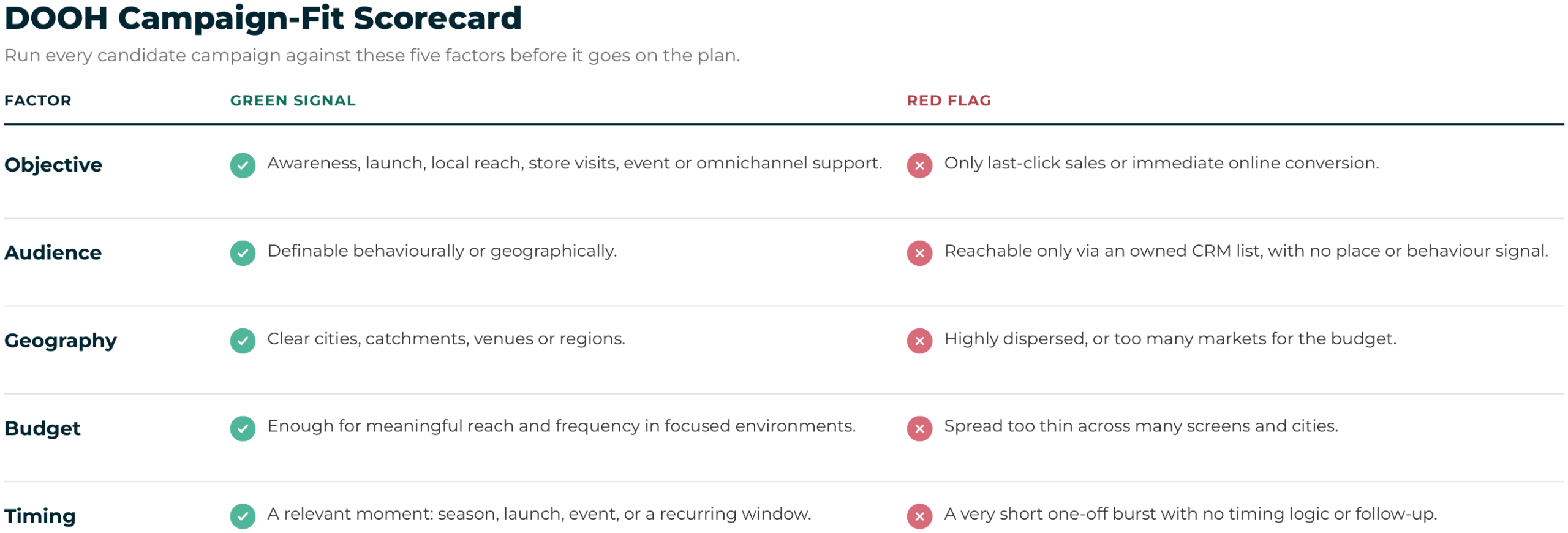
Evaluate every candidate campaign against these five factors before recommending DOOH. Working through them honestly with a client, in a single conversation, is usually enough to know whether DOOH belongs.Worked example, when to say no: a B2B software client wants to reach 40 named enterprise accounts with a highly customised message. The audience is too narrow and dispersed for DOOH to deliver efficiently. This is a better fit for account-based marketing on LinkedIn and email, with DOOH reserved for a broader category-awareness play near a relevant trade fair, if one exists.
The takeaway
DOOH is strongest when visibility, context, geography and timing matter, and weakest for narrow, highly personalised, pure last-click objectives. Audience-first tools have widened what counts as reachable, so “too niche for outdoor” is far less often true than it used to be. Run the five factors before screens, packages or deal IDs ever enter the conversation.