


MINT SQUARE ARTICLE
Understanding the Programmatic DOOH Ecosystem
Seven roles, one campaign. Knowing who does what makes every problem easier to diagnose.
Once a strategy is clear, the last piece is understanding the ecosystem that actually brings a campaign to life. Programmatic DOOH involves several partners, and each one affects planning, access, delivery, creative approval, measurement and reporting. Knowing who does what makes it far easier to diagnose a problem when something goes wrong, and to have an informed conversation when evaluating a new partner.
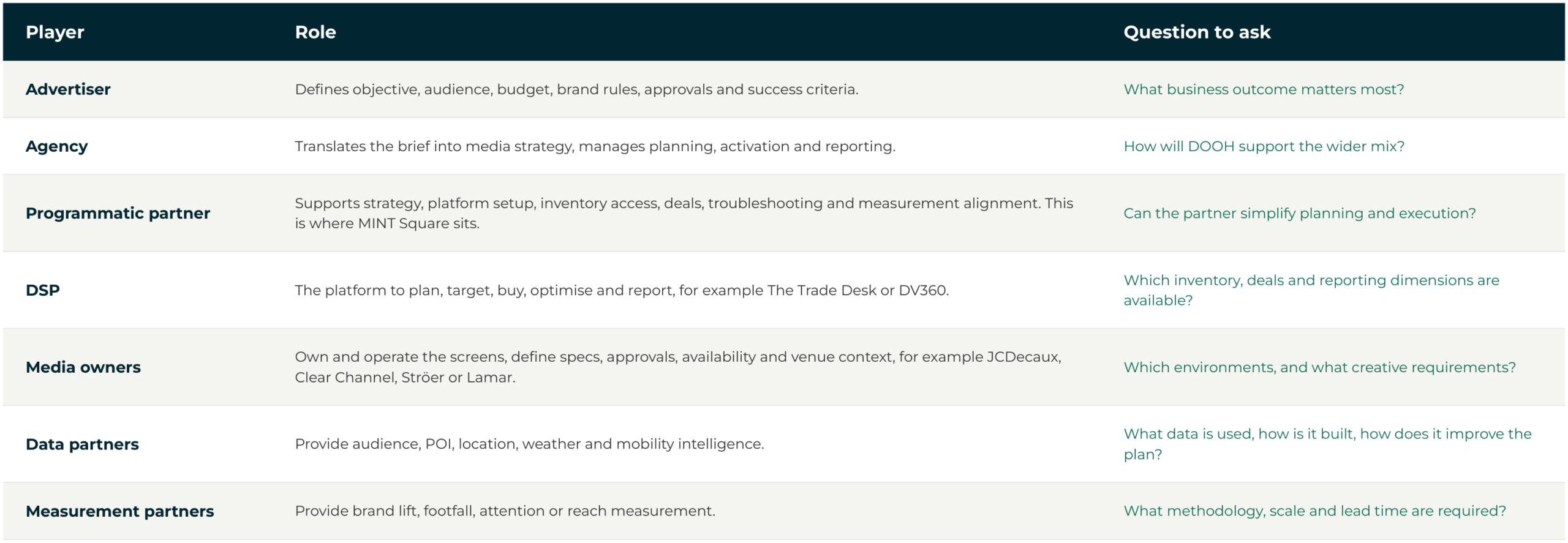
A note on where MINT Square fits: in the VILSA campaign, MINT Square acted as The Trade Desk’s programmatic partner alongside agency Peak Value, the specialist that brings audience-first planning and measurement discipline to the table so the advertiser and agency don’t have to navigate the technical layer alone.
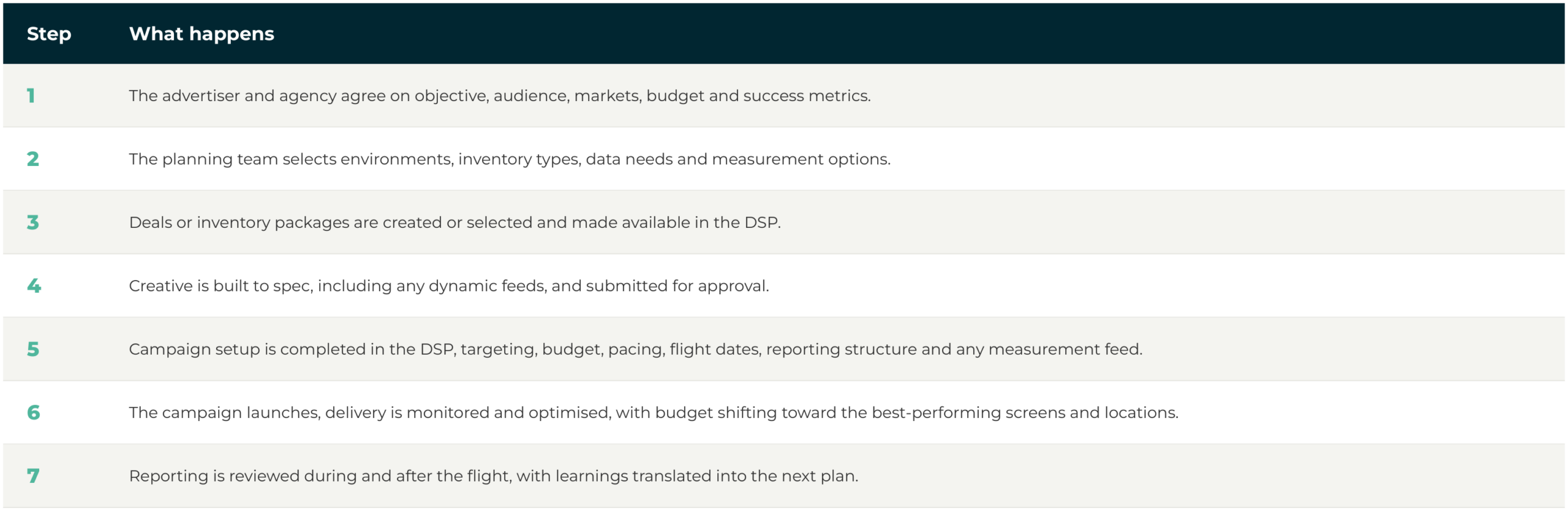
How the different partners actually work together
The buying path typically runs advertiser to agency to programmatic partner to DSP to SSP to media owner. But it isn’t a simple linear chain, data and measurement partners plug in at multiple stages, shaping targeting, optimisation and reporting along the way.
Adsquare’s audience data is a good example of this in practice. It informs targeting at the planning stage, its store-visit feed flows back into the DSP during the flight to guide optimisation, and the same data gets used again at the end for proof of impact. That continuous loop, plan, target, optimise, validate, is what separates a modern DOOH campaign from a traditional one-way booking.
What to look for in a partner
- Operational support. Who actually resolves deal access issues, no-delivery, creative rejections, pacing problems or reporting questions when they come up mid-flight.
- Strategic value. Whether the partner helps sell, explain and improve DOOH within your own client conversations, or just hands over inventory access and leaves the rest to you.
- Transparency. Clear, screen-level reporting rather than opaque, aggregated numbers that can’t be broken down by city, venue or creative.
- Proven measurement partnerships. Established relationships with credible footfall, attention and brand-lift providers, not a promise to figure it out when a client asks.
- Genuine audience-first and dynamic-creative capability. A track record of actually shipping contextually relevant campaigns, not just the theory of how audience-first planning is supposed to work.
- Omnichannel fluency. Comfortable integrating DOOH into a wider media plan and its measurement, rather than treating the channel as a bolt-on that gets reported separately.
- Responsive account and trading support. Someone who flags an underperforming flight before the wrap report arrives, not after the budget’s already spent.
Questions to ask when evaluating providers
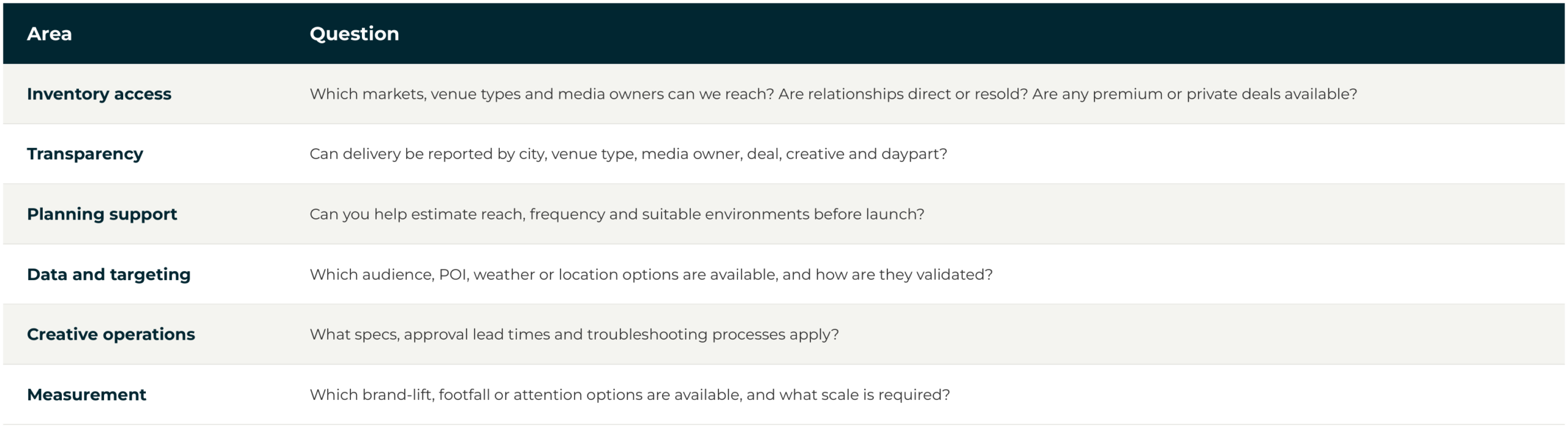
For agencies new to DOOH, a partner’s value isn’t only inventory access, it’s planning guidance, operational clarity, troubleshooting and measurement discipline. If every conversation with a potential partner leaves you with more acronyms and fewer answers, that’s a signal worth paying attention to. A good programmatic DOOH partner explains, in plain language, exactly which media owners and SSPs a budget can reach, how audience-first targeting works, and how you’ll know a campaign succeeded, before anything gets signed.
Want this on hand for your next partner conversation?
All of this comes together in a one-page checklist: nine items to confirm before signing with a programmatic DOOH partner, covering inventory access, audience data sourcing, named measurement partners, fraud and brand safety, screen-level reporting and a clear point of contact for mid-flight optimisation. Download the free Partner Evaluation Checklist and keep it close for your next conversation.

Download the Partner Evaluation Checklist
A nine-question checklist for evaluating programmatic DOOH partners before you sign.
Key takeaways
Seven roles make up the ecosystem, advertiser, agency, programmatic partner, DSP, media owner, data partner and measurement partner, each with a distinct job. Data and measurement partners plug in throughout the campaign, not just at the end, shaping planning, optimisation and validation in turn. Judge a potential partner on clarity, transparency and measurement discipline, not on the length of their feature list.