


MINT SQUARE ARTICLE
DOOH vs. OOH - What's the Difference?
Two very different upgrades.
From Posters to Programmatic: The Two Waves Behind DOOH Advertising
Outdoor advertising has been part of cities for well over a century, and for most of that time, it barely changed. An advertiser commissioned the artwork, a printer produced it, and a crew pasted it up for a fixed number of weeks. It worked, it just wasn’t flexible. Out of home advertising was a broadcast medium in the truest sense, one message, printed once, shown to whoever happened to walk past for as long as the contract ran.
That’s changed, but not all at once, and not in the way a lot of people assume. The shift has happened in two separate waves, and it’s worth being precise about which one you’re actually talking about, because “we already do DOOH” and “we already do programmatic DOOH” describe two very different realities.
Wave one: the poster becomes a screen
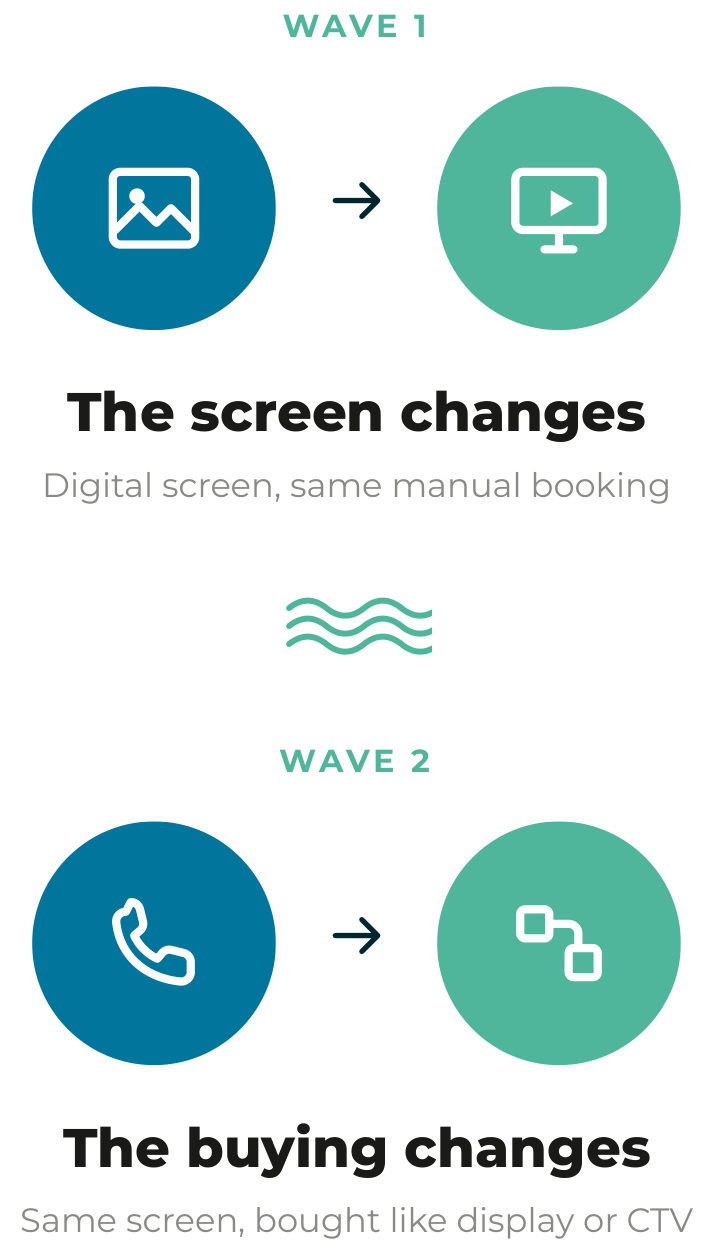
The first wave was digitisation. The printed poster was replaced by a digital screen in the same physical spot, and digital out of home advertising, DOOH for short, was born. Content could now rotate on a schedule, several advertisers could share a single site, and creative no longer needed weeks of print lead time to go live.
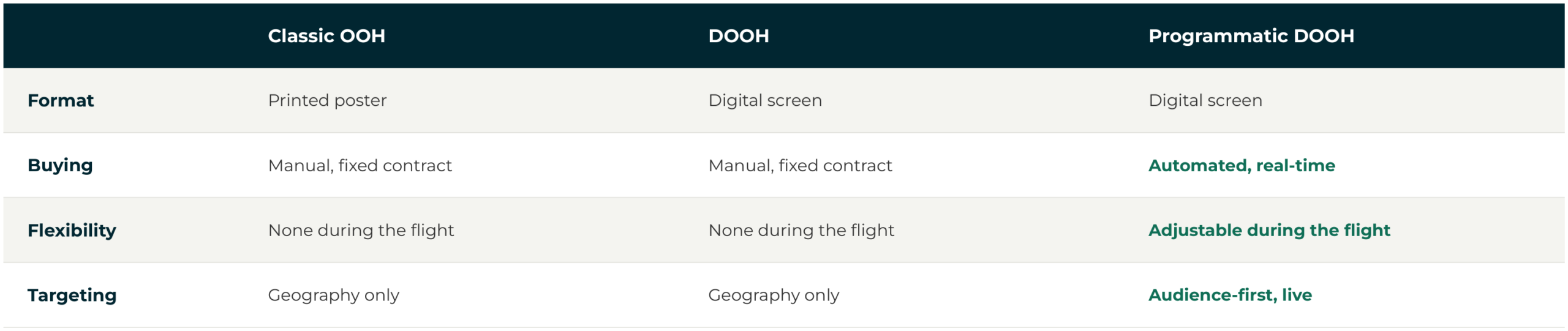
This is what most people mean when they say “DOOH,” and it’s already a real upgrade over static posters. But the buying process stayed exactly the same as before. An agency called a media owner, negotiated a site list, and signed a contract for a fixed flight. The screen went digital. The booking stayed analogue.
Wave two: the buying becomes automated
The second wave is programmatic, and it doesn’t touch the screen at all. It changes how the screen gets bought.
Media owners began making their DOOH inventory available through supply-side platforms (SSPs), and demand-side platforms (DSPs), such as The Trade Desk, built the infrastructure to buy that inventory audience first, in real time, with mid-flight optimisation. That’s exactly how advertisers already buy display, video and CTV. Instead of a phone call and a fixed contract, targeting, budget and creative all sit inside a platform your team may already use for other channels. This is programmatic DOOH, sometimes called programmatic out of home advertising or programmatic OOH, and it’s the version of the channel this guide is really about.
Why the distinction matters
“We already do DOOH” and “we already do programmatic DOOH” are two different claims. The first means a client is running DOOH ads on digital screens, booked the old way, manually, by contract, with no mid-flight flexibility. The second means they’re buying that same screen space the way they already buy display or CTV, targeted, real time, measurable, adjustable while the campaign is live.
Most clients who’ve dabbled in DOOH have only ever experienced the first wave. That’s not a gap in their strategy, it’s untapped budget sitting right next to what they’re already spending. Recognising which wave a client’s current spend is actually in is often the fastest way to spot where a media plan is leaving programmatic OOH opportunity on the table.
The bottom line
DOOH vs OOH isn’t really the useful comparison anymore. DOOH vs programmatic DOOH is. The screen went digital years ago for most major markets, that upgrade is largely done. What’s still genuinely new, and still catching a lot of media plans by surprise, is the second wave, the same inventory, bought the same way the rest of digital media already gets bought. Once you can tell which wave a client’s current OOH spend is sitting in, the conversation about moving them into programmatic DOOH gets a lot easier to have, and it usually starts with budget they’re already committing somewhere else.
Frequently asked questions: DOOH
Impressions are a modelled estimate of how many people were near a screen while it played, not a confirmation anyone saw or responded to it. They can’t answer whether a campaign built awareness or drove a real outcome, which is usually what the client actually wants to know.
It’s the process of matching anonymised, aggregated mobile location data against people exposed to a DOOH campaign, then checking whether they visited a relevant physical location afterwards. It needs a measurement partner and control group set up before the campaign launches.
Usually through a short survey run against an exposed group and a matched control group, asking about recall, message association or purchase intent, to isolate the effect of the campaign from everything else happening at the same time.
Yes. A DOOH flight can show up as a spike in branded search, a lift in site traffic from a relevant area, or an increase in app installs during the campaign window, even though the eventual conversion happened somewhere else. Measurement plans that only look at DOOH’s own numbers miss this effect.
Before launch, not after. KPIs, the measurement partner, sample size and methodology all need to be agreed and built into the brief ahead of time, since several of the better measurement options, like a control group or a brand lift survey, can’t be added once the campaign is already live.